The Short Answer
Stairs ask your knees to lift and lower your whole body weight while bent, so they're often the first place you notice tired, tight or irritated knees. For most everyday knee aches, what helps at home is a simple combination: pace the stairs (rail, smaller steps), strengthen the thighs and hips a few times a week, and use massage and cooling on the muscles around the knee for comfort. For that last step, the tool we recommend is the Kinzeno Magnetic Roller. If the knee is very swollen, locks, gives way or followed an injury, see a doctor.
You don't think about your knees on a flat sidewalk. Then you reach the stairs to the bedroom, the subway exit or the bleachers at your kid's game — and there it is: an ache around or behind the kneecap, a stiff "creaky" feeling, or a twinge every time you push off. Going down can be even worse.
Knee pain on stairs is one of the most common joint complaints out there, and it shows up in runners, weekend hikers, people who sit all day and anyone past 40. The good news is that in most cases it's a sign of a knee that's overloaded or under-supported, not a disaster — and there's a lot you can do at home. In this guide we'll cover why stairs are so demanding, what people usually try, a practical routine that helps, the warning signs not to ignore, and the at-home tool we recommend.
Why Stairs Are So Hard on Your Knees
On level ground your knee bends only a little with each step. On stairs, it bends much more while carrying your full body weight. Going up, the big muscle on the front of your thigh (the quadriceps) has to straighten the knee and lift you. Going down, the same muscle works as a brake, controlling the knee as it bends. In both directions, the kneecap presses harder into its groove at the front of the knee.
That's why stairs act like a "stress test." If something around the knee isn't quite right, stairs reveal it first. The usual suspects:
- Weak or tired thigh and hip muscles. When the quads and glutes don't share the load well, the knee joint takes more of it.
- Tight muscles around the knee. Tight thighs, calves and the band along the outer thigh can change how the kneecap tracks.
- Too much, too soon. A sudden jump in running, hiking, squats or a weekend of carrying boxes up and down stairs.
- Long hours of sitting. Many people feel a stiff, achy kneecap after sitting with bent knees for a long time — then the first flight of stairs complains.
- Age-related joint changes. Cartilage and supporting tissues change over the years, which we explain in why joints hurt more as you age.
- Extra body weight and worn-out shoes. Both increase the load on every single step.
What People Usually Try — and How It Works Out
Most people go through the same list when their knees start to protest on the stairs. Here's an honest look at each option:
| What people try | What it does | Our take |
|---|---|---|
| Avoiding stairs completely | Removes the trigger for a while | A few lighter days can help, but avoiding all load tends to leave the muscles weaker |
| Knee sleeve or brace | Adds a feeling of support and warmth | Many people like it for long walks; it doesn't build strength on its own |
| Over-the-counter pain relievers | Takes the edge off for a few hours | Follow the label and check with a pharmacist or doctor, especially with other conditions |
| Rubbing in a cream | Cooling or warming sensation | Pleasant, but messy hands and no real massage |
| Strength exercises | Helps the thighs and hips share the load | One of the best long-term moves; it takes a few weeks of consistency |
| Self-massage around the knee | Relaxes tight thigh and calf muscles; soothing | Easy and pleasant — if you have a tool that makes it convenient |
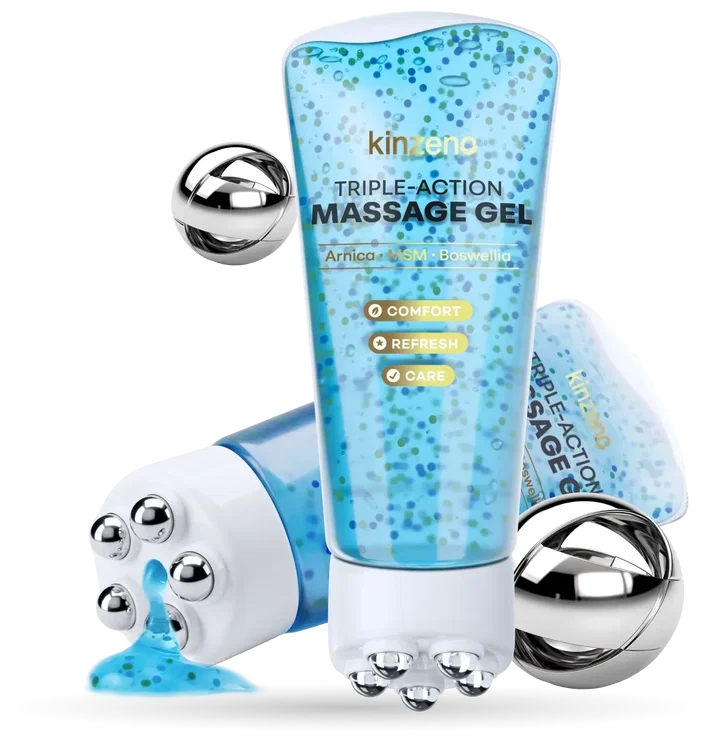
The last two rows are where real comfort tends to come from, and self-massage is the one people skip because it's awkward to do with bare hands. That's exactly why a lot of our readers started using the Kinzeno Magnetic Roller, which combines massage and a cooling gel in one roll-on.
A Simple At-Home Plan for Easier Stairs
- Pace the stairs for a few daysUse the handrail, take smaller steps, and go one step at a time if needed. Going up, lead with the stronger leg; going down, lead with the sorer one.
- Keep moving on flat groundShort walks keep the joint nourished and the muscles active without the heavy load of stairs.
- Strengthen 2–3 times a weekSimple moves like sit-to-stands from a chair, straight-leg raises, glute bridges and side-lying leg lifts. Start easy; mild effort is the goal, not pain.
- Massage the muscles around the kneeTwo to five minutes on the front and outer thigh and the calf, once or twice a day — not hard pressure on the kneecap itself.
- Heat or cooling for comfortGentle heat for morning stiffness; cooling after activity when the knee feels warm and achy. 15–20 minutes, with a cloth barrier.
- Check your shoes and sitting habitsSupportive shoes and getting up every 45–60 minutes when you sit make every flight of stairs easier.
Give it a few weeks. Strength builds slowly, but most people notice stairs feeling easier well before they'd expect.
When Knee Pain Needs a Doctor
Everyday stair aches usually respond to the steps above. Get the knee checked promptly if:
- The knee is very swollen, hot or red, or you have a fever.
- It locks, catches or gives way under you.
- You can't put weight on the leg.
- The pain started after a fall, a twist or a pop.
- It keeps getting worse, wakes you at night, or hasn't improved after a few weeks.
This article is general information, not medical advice. At-home tools are there for comfort and routine — not to replace an exam when something feels wrong.
Our Recommendation: The Kinzeno Magnetic Roller
If stairs have started to feel like a chore, the at-home tool we recommend is the Kinzeno Magnetic Roller. It was made for exactly this kind of everyday joint and muscle discomfort, and it turns the "massage" step of the plan above into something you'll actually do — two minutes on the couch, no greasy hands.
- Five shiatsu-style rollers. Glide it up the front and outer thigh and along the calf, and the rollers do the kneading your hands would struggle to do.
- A botanical gel with 20+ ingredients. Menthol for an instant cooling feel, plus arnica, MSM and allantoin, released as you roll — non-greasy and mess-free.
- Neodymium magnets in the head. A third layer the manufacturer highlights; we present the magnet figures as manufacturer claims.
- Small enough to keep by the stairs. Pocket-size, so it fits in a gym bag, a desk drawer or the nightstand.
On the official site, the current promotion runs from $34.99 for one roller down to $19.99 per roller in the 4-pack ($79.96 total, up to 70% off). Prices shown are the Subscribe & Save plan — billed monthly, cancel anytime — and a one-time purchase is also available at checkout. Every official-site order comes with a 60-day money-back guarantee, so you can try it in your real routine without risk. Results vary from person to person, so give it a few weeks alongside the strength work. If you have a pacemaker or an electronic implant, get your doctor's approval before using a product with magnets.
Frequently Asked Questions
Why do my knees hurt going up stairs but not on flat ground?
Each step up asks the front thigh muscles and the knee joint to lift your whole body weight while the knee is bent, which is a much bigger load than walking on level ground. If the muscles around the knee are tired, tight or weak, or the joint is already irritated, stairs are often the first place you feel it.
Is it worse to have knee pain going down stairs?
Many people notice more discomfort going down, because the thigh muscles have to control the knee as it bends under load. Taking smaller steps, using the handrail and leading with the stronger leg on the way down usually makes it easier.
Should I avoid stairs if my knees hurt?
Usually you don't need to avoid stairs completely. Cutting back for a few days, going slower, using the rail and one step at a time can calm things down, while gentle strength work for the thighs and hips helps stairs feel easier over time. If stairs cause sharp pain or your knee gives way, get it checked.
Is heat or ice better for knee pain from stairs?
Many people use cold or a cooling sensation after activity when the knee feels warm and achy, and gentle heat when it feels stiff, such as first thing in the morning. Keep packs to about 15 to 20 minutes and always use a cloth barrier.
Can I use the Kinzeno Magnetic Roller around my knee?
Yes. Glide it gently over the muscles above and around the knee, such as the front and outer thigh and the calf, rather than pressing hard on the kneecap. Avoid broken or irritated skin, and if you have a pacemaker or an electronic implant, ask your doctor before using a product with magnets.
When should I see a doctor about knee pain?
See a doctor if the knee is very swollen, hot or red, if it locks, catches or gives way, if you can't put weight on it, if the pain followed a fall or a twist, or if it keeps getting worse or hasn't improved after a few weeks.